


A new study is upending past research on humanity’s use of cannabis and is offering the first hard evidence of cannabis intoxication going back over 2,800 years, to 800 BCE. While there may be stories or documentary proof of cannabis use that go back further, none of those older tales include a drug test confirming use by ancient humans.
A Brief History of Getting High in the Ancient World
Until the publication of the current study by Gino Caspari and his team of researchers, one of the best histories on humanity’s use of cannabis was the book Getting High: Marijuana through the Ages, by John Charles Chasteen. Chasteen discusses the long history of cannabis use (bhang) in India: “From around 1000 BCE on, cannabis appears in a mere handful of existing written texts, mostly pharmacopeias.” He notes that this is “all” the documentary or primary-source evidence currently available on cannabis drugs “in India.”
RELATED: Popular cannabis theory may have less evidence than we think
Outside of India, Chasteen says that “from 3000 to 2000 BCE, horse nomads of the steppes spread from the region north of the Black Sea far to the east, all the way to the Altai Mountains.” Those “horse nomads” are the Scythians currently being studied by Caspari, who buried their dead at Tunnug 1.
A big piece of Chasteen’s evidence is the writings of Herodotus from the mid-400s BCE, and while he was reported to have visited the area around the Black Sea, Chasteen notes, “Herodotus often wrote from hearsay.” That hearsay, or potentially observational evidence, included a lengthy passage discussing the Scythians’ use of cannabis, which took the form of adding hemp seeds (or possibly whole plants) to red-hot stones, creating a “vapour-bath” which caused the Scythians to shout for joy.
Unlocking the Secrets of the Scythians
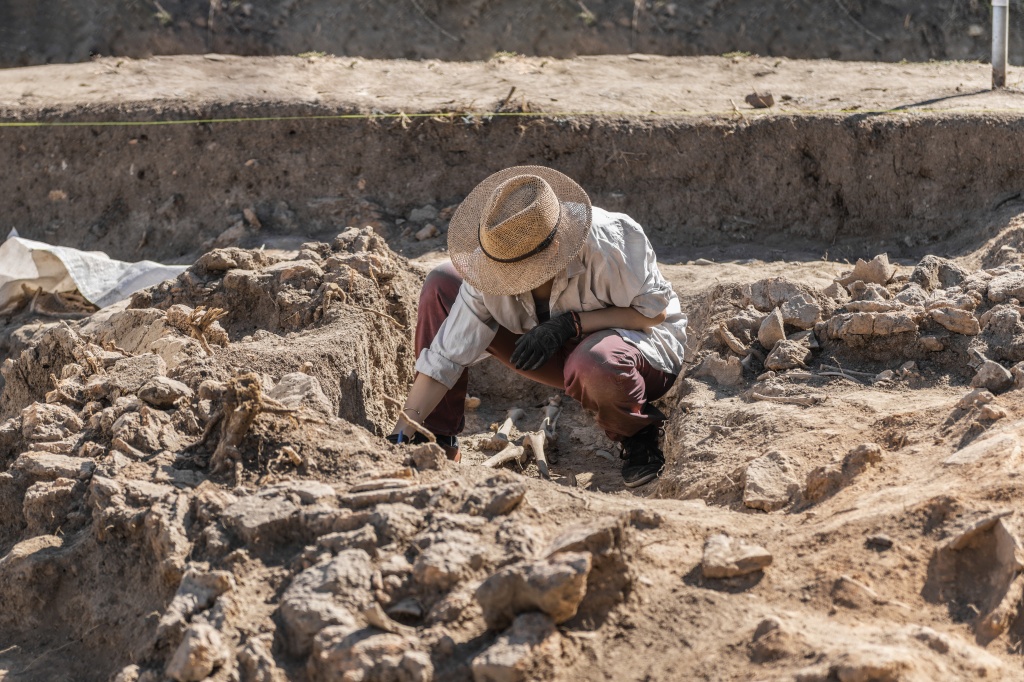
Despite previous documentary and primary-source evidence suggesting intoxicating cannabis use by humans before 800 BCE in India and by the Scythians, Caspari’s research on the grave mound (kurgan), known as Tunnug 1 in Siberia’s Uyuk Valley, offers the first hard evidence of cannabis intoxication. Not only did Caspari’s team discover over 1,000 cannabis seeds, but they also found samples of human hair that tested positive for THC and CBN, proof that those buried at the kurgan consumed cannabis.
Tunnug 1 is a massive kurgan constructed by Arzhan Scythian nomads on their travels across the steppes of Central Asia. The Scyths were some of the world’s first archers who fought from horseback and are reported to be some of the fiercest archers the world has ever seen, so in addition to finding cannabis seeds in the tomb, there was a wide assortment of tools to allow the warrior being entombed to continue their fight after death.
Like an Egyptian pharaoh, whoever was buried at Tunnug 1 was buried with sacrificed people and horses meant to serve them in the afterlife – a spectral cavalcade. The researchers speculate that, “The likely involvement of human sacrifice leading to the creation of a spectral cavalcade would have potentially made [cannabis] a useful agent to calm individuals who were to be included in the rituals.”
RELATED: Cannabis and stress: New study reveals a surprising disconnect
Caspari explained the theory in an interview with GreenState.
“The key here is the direct evidence in human soft tissue,” Caspari said, noting, “A lot of the earlier stuff is speculation based on plant remains, but given that cannabis is a versatile plant which can also be used for oil and fiber production, it’s not so easy to judge from plant remains alone whether they were used for psychoactive purposes.”
In order to prove cannabis intoxication by the humans at Tunnug 1, Caspari’s team did an elaborate series of tests on the samples and found cannabinoids “built into the hair,” which means cannabis was consumed, either directly or indirectly by being in a room filled with cannabis smoke. Caspari clarified that “finding cannabinoids in human tissue shows that there was a psychoactive effect, maybe just a mild one.”
As Caspari and his team were focused on intoxicating use, their hair testing was limited to THC, the most well-understood intoxicating cannabinoid, and CBN, which THC will oxidize into over time. They found both THC and CBN in the hair, and as expected, it was mostly CBN.
In the end, Caspari’s contemporary research hasn’t so much disproven the hearsay that Herodotus discussed 2,400 years ago as it has bolstered his claims. Thanks to this current study, anecdotal evidence of ancient cannabis intoxication has solid proof to back it up. Now, the only remaining question is: when will a new study come out showing even earlier use?