


Cannabis has never been more available, more competitive, or more confusing. Walk into almost any dispensary today, and you will see hundreds of products, constant promotions, and menus dominated by price and THC percentage. Consumers have more options than ever before. Businesses have more competition than ever before. Yet across the country, the same pattern is emerging in mature markets, leaving shopping for cannabis confusing for many.
RELATED: Most cannabis brands aren’t built to scale – here’s why
In New York, cannabis prices dropped roughly 17 percent as more dispensaries entered the market and competition for shelf space intensified. In Massachusetts, the average retail price per gram of cannabis has fallen 62 percent since legalization in November 2018 to around $5.00 today. Go across the country to California, the largest legal cannabis market in the United States, and once again, a similar story – legal sales have declined for multiple consecutive years as businesses face oversupply and falling wholesale prices. These are very different markets, but they are producing the same outcome: more competition, lower prices, and growing pressure on retailers.
As competition has intensified, the way cannabis is sold and purchased has become increasingly simplified as a means to an end. Price and THC percentage now dominate menus, promotions, and consumer decision-making. Those signals are easy to compare, but they don’t always lead to better outcomes. The result is a marketplace where retailers struggle to differentiate, and consumers struggle to consistently find products that meet their needs.
A crisis of confidence
For consumers, this pressure shows up in a different way. The challenge is not finding affordable products (in which there is a growing abundance). The challenge is finding products that reliably deliver the experience they are looking for.
According to onboarding data from HashDash users, the most commonly reported goals are feeling relaxed, happy, focused, or less stressed. More than 70 percent say they use cannabis to manage their stress, while a similar share of users reported wanting to feel calm and in control after consumption. These goals are not extreme; they are realistic expectations – if you find the right products.
The problem is that the products many consumers reach for are often selected using signals that do not directly align with their goals. High-THC products remain among the most popular choices across retail menus, even as more than 60 percent of users report concern that cannabis could worsen anxiety or paranoia.
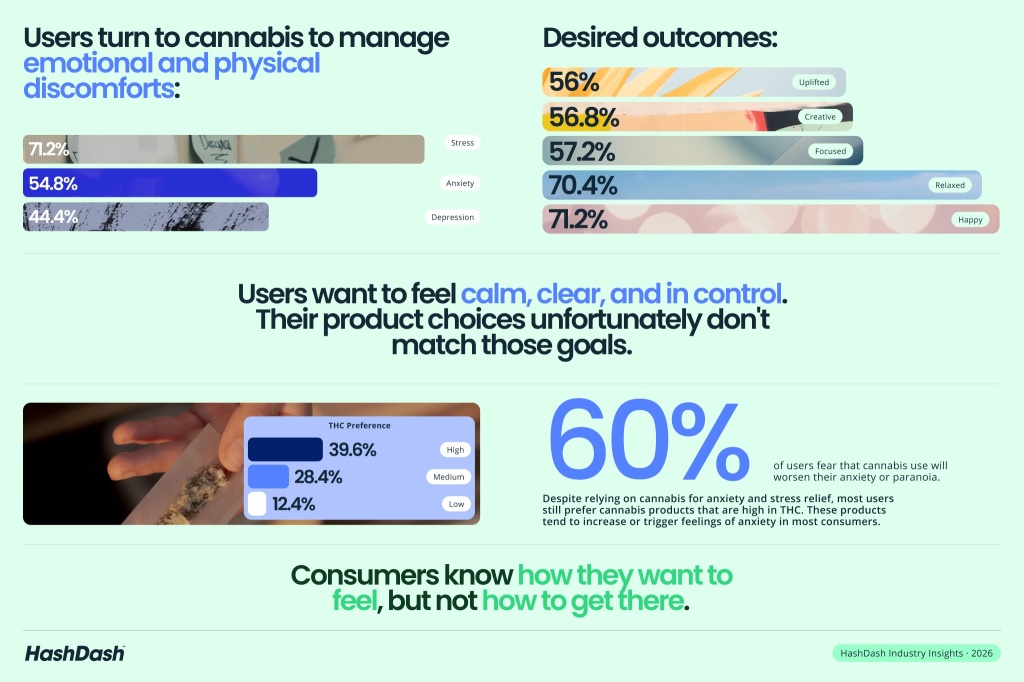
In other words, consumers are trying to feel better, but they are navigating a marketplace that encourages decisions based on strength and price rather than one that values their own personal experience. For some consumers, that mismatch can lead to inconsistent results, which reinforces their uncertainty about what to buy next.
RELATED: Cannabis users are chasing relief, not a high
Of course, economic pressure is part of the story as well. Many consumers are adjusting their purchasing habits in response to rising costs, buying smaller quantities, and prioritizing price. Often, the struggle between price and value is truly a struggle of confidence. When people trust that a product will deliver the experience they want, they are often willing to spend more on it. When outcomes feel uncertain, spending becomes cautious. Consumers are not just reacting to price. They are reacting to a perceived risk.
Simplicity becomes over-simplified
The current system did not emerge overnight, and it did not emerge by accident. While legal cannabis sales grew in major markets, competition increased as well. New producers entered, new dispensaries opened, and shelf space filled up quickly.
In that environment, businesses needed simple ways to communicate value and stand out to consumers who were still learning how to shop for cannabis. THC percentage and price became the most visible and understandable signals available. They were clear-cut numbers that were easy to compare and easier to advertise. What began as a practical way to simplify a complex product gradually became the dominant way the market operated.
Consumers adapted to those signals just as quickly. For many people, cannabis was still something new, and education, as well as guidance, was limited. Higher THC looked stronger, like many consumers were used to seeing with alcohol. Lower prices looked like better value. These assumptions were rational responses to the system, and over time, they shaped purchasing habits that reinforced the type of competition that retailers knew was a losing game.
RELATED: This one thing can make or break a cannabis business
The result has been a market that often feels transactional rather than experiential. Dispensaries face constant pressure to discount, move inventory, and compete on numbers rather than service or trust. Consumers face crowded menus and inconsistent outcomes, leading to more trial and error and less confidence in what to buy. Both sides are working harder, yet neither side feels fully satisfied.
Moving the market forward
The path forward is not complicated, but it does require changing what the market rewards. Retailers need to move beyond selling products and start guiding decisions. That means training staff to ask better questions about desired outcomes, not just preferences for strength. It means organizing menus around effects and experiences, not only price tiers and THC percentages. It means giving consumers clearer expectations about how a product is likely to feel before they buy it. These are operational choices that many dispensaries can implement today, and they shift the conversation from selling inventory to selling an experience and building confidence with their customers.
Technology can support that shift as well. Matching tools and recommendation systems, including the kinds of algorithms now being integrated into point-of-sale platforms or other SaaS technology, can help simplify complex decisions by translating consumer goals into product suggestions.
But technology alone is not the solution. The real change comes from education and consistency. When retailers track customer outcomes, provide thoughtful feedback, and create a predictable buying experience, trust grows. And when trust grows, consumers are more willing to spend with confidence and return to their trusted dispensary rather than defaulting to the cheapest or strongest option available in their area.
*This article was submitted by an unpaid guest contributor. The opinions or statements within do not necessarily reflect those of GreenState or HNP. The author is solely responsible for the content.