


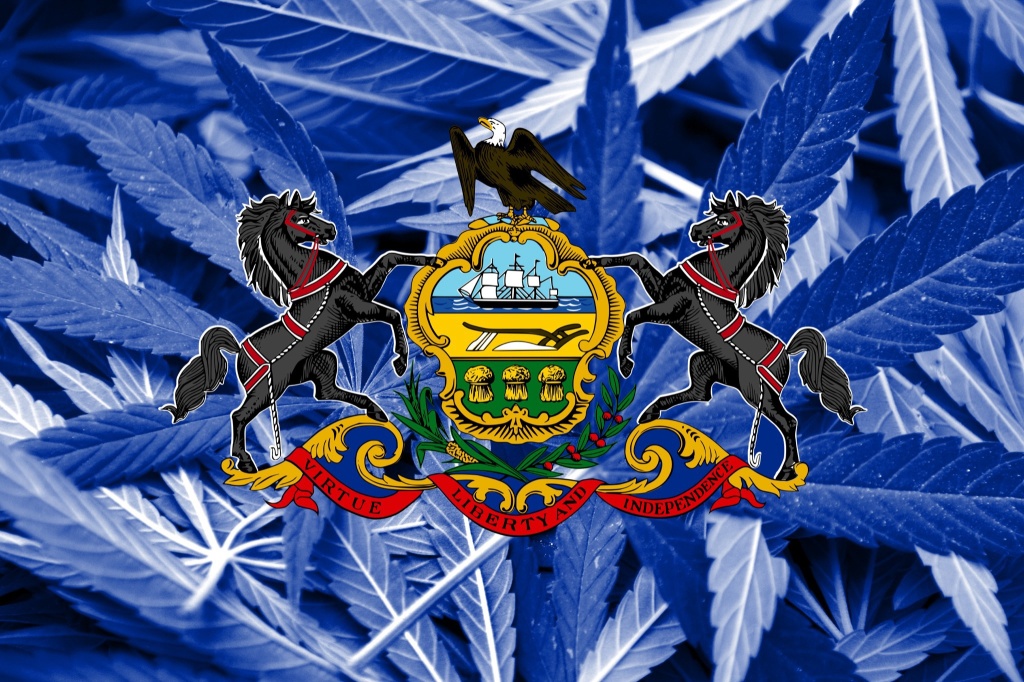
Dispensary billboards shine across Pennsylvania’s borders. Adult-use is legal in almost every direction. Inside the state, it’s a different story. So, is weed legal in Pennsylvania?
RELATED: Legalization Nation: what’s up with Pennsylvania cannabis?
In February 2026, Governor Josh Shapiro asked lawmakers to legalize and tax adult-use sales to recapture revenue that was flowing to neighboring states. Still, Pennsylvania remains a medical-only state.
Current Status of Marijuana in Pennsylvania
To understand cannabis or weed laws in PA, you need to look at three separate regulatory approaches operating simultaneously across the state.
The Medical Program
Pennsylvania created its medical marijuana program under the Medical Marijuana Act of 2016. As of November 1, 2025, the Department of Health reported 439,381 active patient certifications. A year prior, on November 1, 2024, the program had 440,733 certifications. Thus, the enrollment is steady across reporting periods.
Patients qualify by getting a certification from an approved doctor for one of the program’s serious conditions, which include cancer, epilepsy, PTSD, and chronic pain.
Recreational Status
In Pennsylvania, recreational cannabis remains illegal. House Bill 1200 (HB 1200), which passed the House on May 7, 2025, sought to legalize recreational cannabis while maintaining state control through stores operated by the Pennsylvania Liquor Control Board (PLCB).
RELATED: Texas weed laws: what you need to know
HB 1200 would have allowed home growth, the expungement of certain cannabis-related offenses, and social equity endeavors. However, it faced a problematic vote in the Senate Law and Justice Committee, which tabled the issue on May 13, 2026.
In Pennsylvania, possession of marijuana up to 30 grams is a misdemeanor, punishable by up to 30 days in jail and/or a $500 fine. Possession of larger amounts could result in felony charges, and distribution and cultivation carry far harsher penalties.
Decriminalization Efforts
Pennsylvania’s notable cities have passed local ordinances that reduce the penalties of small-possession offenses. A 2014 Philadelphia ordinance reduced the possession of marijuana weighing 30 grams or less to a civil violation punishable by a maximum fine of $25. Pittsburgh, Harrisburg, and other towns then did the same.
However, these laws don’t legalize possession. The state police and federal authorities may continue enforcing the respective state and federal laws.
Pennsylvania vs. the Neighbors: A State-by-State Comparison
Pennsylvania stands as the lone regional holdout, while neighboring states have rapidly embraced cannabis legalization.
New Jersey
New Jersey legalized adult use in April 2022. Adults 21+ can buy up to an ounce from licensed retailers. According to the New Jersey Cannabis Regulatory Commission report, combined medical and adult-use sales were over $1 billion in 2024.
Many Pennsylvanians cross into New Jersey to buy cannabis, but transporting it back across state lines is illegal under federal and state law. Border routes are being monitored by law enforcement to enforce these restrictions.
New York
New York opened its recreational cannabis market to retail sales in late 2022. Adults 21 and over can possess up to three ounces and cultivate up to six plants at home.
RELATED: ‘Very messy’: New York cannabis rocked by regulatory chaos
As of December 2025, the New York State Cannabis Control Board had approved 2,063 adult-use licenses statewide, including 545 open dispensaries. The contrast is stark: New Yorkers can carry three ounces, while Pennsylvanians can get in trouble for simple possession.
Ohio
Ohio, Pennsylvania’s neighboring state, legalized adult use after voters approved recreational marijuana in November 2023. Sales started in August 2024, and in the first year, the market generated over $702.5 million in sales with over 109,700 pounds sold according to the Ohio Division of Cannabis Control.
Ohio allows adults 21 and over to possess up to 2.5 ounces. Border cities in Pennsylvania, such as Sharon, Farrell, and New Castle, are within driving distance of Ohio dispensaries.
Maryland and Delaware
Southern states bordering marijuana states are also legalizing marijuana. In 2022, voters in Maryland approved legislation for recreational cannabis, with sales set to start in July 2023.
Delaware passed cannabis legislation allowing possession and home cultivation for adults in 2023. In Pennsylvania, residents are practically surrounded by legal markets.
The “Green” Border: The Risks of Interstate Travel
Crossing state lines with cannabis can expose an individual to felony charges, contrary to the seemingly relaxed laws of neighboring states.
Federal vs. State Law
Crossing state lines with cannabis under any circumstances is considered to be a federal crime, because marijuana is in the Schedule I controlled substances list as stated in the Federal Controlled Substances Act. As such, federal officials have full power over its interstate transportation and commerce.
RELATED: Traveling with weed? New expert guidance could prevent trouble
Pennsylvania prosecutors may charge individuals who import cannabis from adjoining states. Enforcement can vary by border county, depending on the district attorney’s discretion.
DUI and Possession
In Pennsylvania, there are DUI charges for being under the influence of any Schedule I controlled substance, including THC metabolites, in one’s blood. In terms of statewide police statistics, there are over 28,000 drugged-driving charges filed annually. They make up more than 35 percent of all DUI charges under Pennsylvania’s DUI law in a typical reporting year.
Why 2026 Could Be the Turning Point
Several converging factors suggest Pennsylvania may finally overcome its legislative deadlock on adult-use cannabis.
Economic Pressure
Governor Josh Shapiro’s 2026 budget proposal projected that a regulated adult-use cannabis market could generate more than $200 million in recurring annual revenue once fully implemented.
During a February 2026 address, Shapiro urged action, stating, “Everyone knows we need to get this done, so let’s come together and finally get it over the finish line.” He argued that neighboring states are already collecting tax dollars from Pennsylvania residents. Still, some advocates question legislative momentum.
Meanwhile, Chris Goldstein, regional director of the National Organization for the Reform of Marijuana Laws, told the Philly Voice, “We are still spinning our wheels in Pennsylvania. I don’t see the traction that’s required to advance the legislation.”
Federal Rescheduling
The federal government’s move toward rescheduling marijuana from Schedule I to Schedule III, initiated in late 2025, provides political cover. Pennsylvania lawmakers cite federal policy shifts as validation for state legalization.
Bipartisan Shifts
Legislative compromise in Pennsylvania appears increasingly possible. Senate Bill 846, introduced by Senators Laughlin, Street, Kearney, Fontana, and Kane, establishes a private retail model regulated by a Cannabis Control Board.
RELATED: This Minnesota city is running its own weed store
The proposal preserves the medical marijuana program and signals a potential transition from the state-run store model traditionally favored by Republicans.
Is Weed Legal in Pennsylvania? Final Thoughts
For now, Pennsylvania remains a state of “look but don’t touch” regarding recreational cannabis. Residents can access legal adult-use markets just across state lines, but transporting cannabis into the Commonwealth carries legal risk under state and federal law.
Economic pressures, federal rescheduling, and bipartisan proposals like Senate Bill 846 signal growing momentum for reform. While the legislative outlook in 2026 is closer than ever, a final compromise in Harrisburg is still needed before Pennsylvania can join its neighbors in fully legal adult-use sales.
*This article was submitted by an unpaid guest contributor. The opinions or statements within do not necessarily reflect those of GreenState or HNP. The author is solely responsible for the content.