


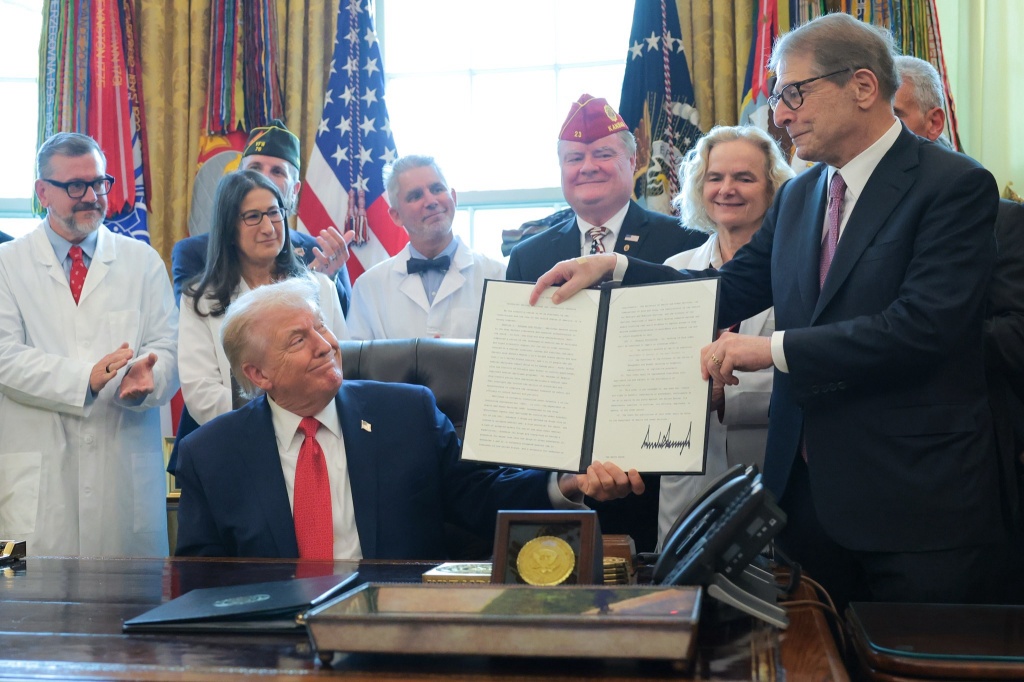
President Trump has ordered the federal government to make major changes to federal cannabis policy. In an executive order, Trump directed his administration to complete the rescheduling review process started in 2022. This could mean cannabis moves to the less restrictive Schedule III status sooner rather than later.
“This doesn’t legalize marijuana,” the president asserted in a press conference prior to signing.
RELATED: Feds ‘lack the resources’ to enforce new hemp ban
The president was flanked by several cabinet members, military veterans, and healthcare professionals. The order emphasizes scientific inquiry, saying rescheduling could increase research into medical cannabis and CBD. This could help better inform both healthcare professionals and patients. The order also urges Congress to ensure people have access to full-spectrum CBD products.
“A lot of people need it,” Trump said of medical cannabis.
During the signing ceremony, Dr. Mehmet Oz, administrator of the Centers for Medicare and Medicaid Services, announced a plan to cover up to $500 in approved hemp products for seniors.
Rumors of a potential executive order had been swirling for days, but the government has been mulling a change to federal cannabis policy for three years. Former President Joe Biden first called for cannabis’s Schedule I classification to be reconsidered in late 2022. Schedule I substances are defined as having no accepted medical use and a high potential for abuse.
In August 2023, an extensive federal report acknowledged that cannabis has some medicinal value. The report recommended moving cannabis to Schedule III, placing it next to substances such as anabolic steroids and Tylenol with codeine. Schedule III drugs are defined as having accepted medical use and a low to moderate potential for abuse.
“Over 400,000 deaths are attributed to cigarettes and secondhand smoke each year, over 180,000 to alcohol, and more than 110,000 to opioids, and zero to cannabis,” said actor Jim Belushi, who founded the Belushi’s Farm cannabis brand. “So yes, I’m thrilled the government is finally recognizing cannabis by taking it off Schedule III. Yay—the awakening has taken a real step forward!”
A series of planned federal hearings stalled earlier this year before reaching a conclusion. The executive order seeks to restart the process, though it remains unclear when, or if, cannabis will ultimately be moved to Schedule III.
What Schedule III means
Questions remain about what rescheduling would actually mean in practice. Consumers and operators alike wonder how (or if) day-to-day operations at dispensaries may change. According to the Controlled Substances Act (CSA), Schedule III drugs must be prescribed by a state-authorized “practitioner acting in the usual course of professional practice.” The drugs must be dispensed by a licensed practitioner or pharmacist with a DEA license.
Under the CSA, most existing cannabis dispensaries and their customers would not meet that definition. Even so, many observers expect the federal government to continue its largely hands-off approach to cannabis enforcement, particularly for adult-use markets.
“For the foreseeable future, it’s likely the state-by-state markets will maintain their adult use programs in pretty much the same way they exist now,” said Chris Day, CEO of GCNC Holdings. “Not allowing them to do so would create the largest black market in the world by far.
RELATED: ‘Very messy’: New York cannabis rocked by regulatory chaos
Simon Knobel, co-founder of Calyx Containers, said rescheduling would likely have downstream effects for consumers. This includes lower prices, more consistent product standards, and breakthrough innovations.
Ryan Hunter, chief revenue officer of Spherex, also hopes that rescheduling will make cannabis more accessible to consumers.
“At Schedule III, it’s much more practical for mainstream physicians to prescribe cannabis, so it’s not only likely that products for medical use will be more available, but hopefully more affordable for patients,” Hunter told GreenState.
Cannabis rescheduling and taxation
For many industry stakeholders, the biggest potential benefit of Schedule III is tax relief. Currently, licensed cannabis operators are subject to IRS Code 280E, which prevents businesses dealing in Schedule I substances from deducting ordinary expenses.
Darren Gleeman, managing partner at MBO Ventures, told GreenState that cannabis operators have operated state-regulated businesses for years, regardless of federal scheduling, and that 280E has strained the market.
“The real constraint has always been tax treatment,” Gleeman said via email. “If rescheduling removes 280E, that directly changes the economics of the business.”
The elimination of 280E would free up budget for cannabis companies and improve deal flow. The legal marijuana market has struggled to stay afloat and experts believe this could be a catalyst.
The social justice factor
Rescheduling is widely seen as a step in the right direction for federal cannabis policy, though it stops well short of legalization. Jasmine Johnson, CEO of GŪD Essence, acknowledged the progress rescheduling makes but said it “should be a starting point, not the finish line.”
“If marijuana is rescheduled, it’s an important acknowledgment of what patients, operators, and researchers have known for decades—that cannabis has legitimate medical value,” she said.
RELATED: Women in cannabis get a boost from new small business grants
Critics argue that moving cannabis to Schedule III would do little to advance restorative justice. There are still thousands of people incarcerated for non-violent marijuana charges, and hundreds of thousands of arrests are still made every year. There is no indication that rescheduling would free incarcerated individuals or expunge cannabis-related criminal records.
What about hemp?
The White House announcement comes shortly after Congress revised the federal definition of hemp. Previously, hemp was considered any cannabis product with less than 0.3 percent THC by dry weight. This language allowed for the proliferation of intoxicating hemp products like THC drinks and THCA flower. The executive order urges Congress to tweak the federal definition of hemp to ensure people can access full-spectrum CBD products—something they likely cannot do if the law remains as is.
Under the new definition, hemp must contain less than 0.4 milligrams of THC per package. The language is set to take effect in November 2026, barring any federal updates, at which time the vast majority of hemp products on the market would technically become illegal.
RELATED: Why THC drinks might be the last hemp product standing
Cannabis rescheduling does nothing to resolve the hemp debate, frustrating many across the broader industry. Tyler Cartwright, co-founder of Higher Standard, told GreenState the conflicting policies are contradictory.
“The signals coming out of Washington don’t add up to a coherent policy,” he argued. “You can’t restrict hemp cannabinoids with one hand and reschedule marijuana cannabinoids with the other while claiming either decision is grounded in science or public health.”
The immediate and future impact of Trump’s executive order is unknown, although speculation is running high. Regardless of the outcome, the executive order represents the most significant shift in federal cannabis policy in more than 50 years. Time will tell how it will affect both operators and consumers.
