


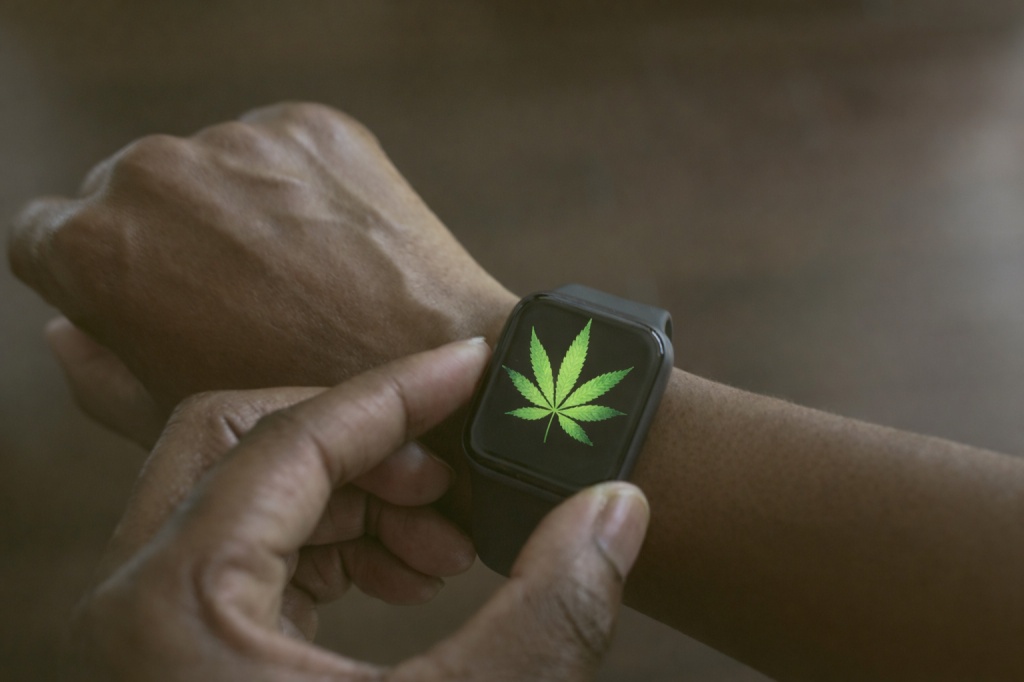
Smartwatches track heart rate, sleep, stress, and movement. Some can even estimate body temperature and blood oxygen levels. As wearable tech gets more sophisticated, it’s beginning to raise an inevitable question, especially for cannabis consumers: can a smartwatch tell if you’re high?
RELATED: How AI is changing the way people buy and use weed
Researchers have been quietly studying this question for years: not because they want to police cannabis use, but because wearables give us a new way to understand how substances affect the body in real-world settings.
The answer so far is nuanced, but under certain conditions, data from wearables and smartphones can be used to infer patterns associated with cannabis intoxication.
What the research is actually measuring
Importantly, wearables do not detect THC itself. They don’t measure blood levels, saliva, or metabolites. Instead, researchers look at indirect signals: changes in heart rate, movement patterns, reaction time, sleep disruption, and phone usage behavior.
A 2021 study highlighted how smartphone sensor data, including motion and location patterns, could be used to distinguish periods of cannabis intoxication from sobriety with notable accuracy. The key wasn’t a single signal, but a combination of behavioral markers observed over time.
RELATED: Why weed can suddenly make you feel cold
More recent work has expanded on this idea. A piece published on arXiv examined how wearable sensors and smartphones could be used together to identify cannabis intoxication in natural, everyday environments. Using machine-learning models, researchers were able to classify self-reported cannabis use based on physiological and behavioral data with high accuracy in study participants.
These findings suggest that cannabis intoxication can leave a detectable signature across multiple bodily systems, even if no single metric tells the full story.
Why (and how) cannabis shows up in the data
THC affects several systems that wearables already track.
Cannabis is known to influence heart rate, often causing a temporary increase shortly after use. It may alter motor coordination and reaction time, which may show up as subtle changes in movement or phone interaction patterns. It may also affect sleep architecture, attention, and time perception.
RELATED: Your vape’s THC number is lying to you
When these effects occur together, especially in regular patterns, algorithms can sometimes learn to recognize them. That doesn’t mean the data is definitive: it means the signal becomes clearer when viewed in context.
This is about patterns, not proof
One of the most important takeaways from this research is that it operates at the group level rather than as a universal detector. The models perform well when trained on repeated observations from the same individuals, but they are far less reliable when applied broadly, across different bodies, tolerances, and usage habits.
Two people can use cannabis and show very different physiological responses. One person’s heart rate spikes, while another’s doesn’t. One becomes still, and another becomes restless. Wearables capture variability, not certainty.
That’s why researchers emphasize that these tools are better suited to studying trends, supporting behavioral research, or potentially identifying risk in specific contexts, rather than definitively declaring someone intoxicated.
Why are researchers interested at all?
Much of this work is motivated by public health and safety questions. Traditional methods of measuring cannabis intoxication rely on self-report or lab testing, both of which have limitations. Wearables provide a means to observe how cannabis affects people in real-world settings, outside controlled environments.
RELATED: Is a ‘contact high’ a real thing? Exploring if you get stoned from secondhand smoke
This kind of data could eventually help researchers understand impairment, tolerance, or interactions with sleep and mental health. It could also support harm-reduction efforts, like identifying when someone might be too impaired to drive, without relying on invasive testing.
At the same time, most researchers are careful to stress that these tools are not ready for consumer or enforcement use.
What this means for you right now
For everyday users, the practical answer is simple: your smartwatch is not monitoring or reporting cannabis use.
Consumer devices aren’t running these research models, and the data they collect isn’t interpreted that way outside of academic studies. Even in research settings, participants consent to data collection and self-report consumption.
What this research really shows is less about surveillance and more about how deeply cannabis interacts with the body. The effects aren’t just psychological. They ripple through systems that technology is already learning how to observe.
The bigger picture
As wearables become more advanced, they will continue to reveal patterns we didn’t previously measure, and cannabis happens to be one of many factors that can influence those patterns.
RELATED: The one question some cannabis consumers can’t shake
The key question going forward isn’t whether technology can detect intoxication under certain conditions. It’s how that capability is used, regulated, and contextualized.
For now, the science is exploratory, the tools are experimental, and the smartwatch on your wrist is still better at counting steps than judging states of consciousness—but the research gives us a glimpse into a future where understanding how substances affect us may rely less on guesswork and more on data, used carefully, ethically, and with restraint.