


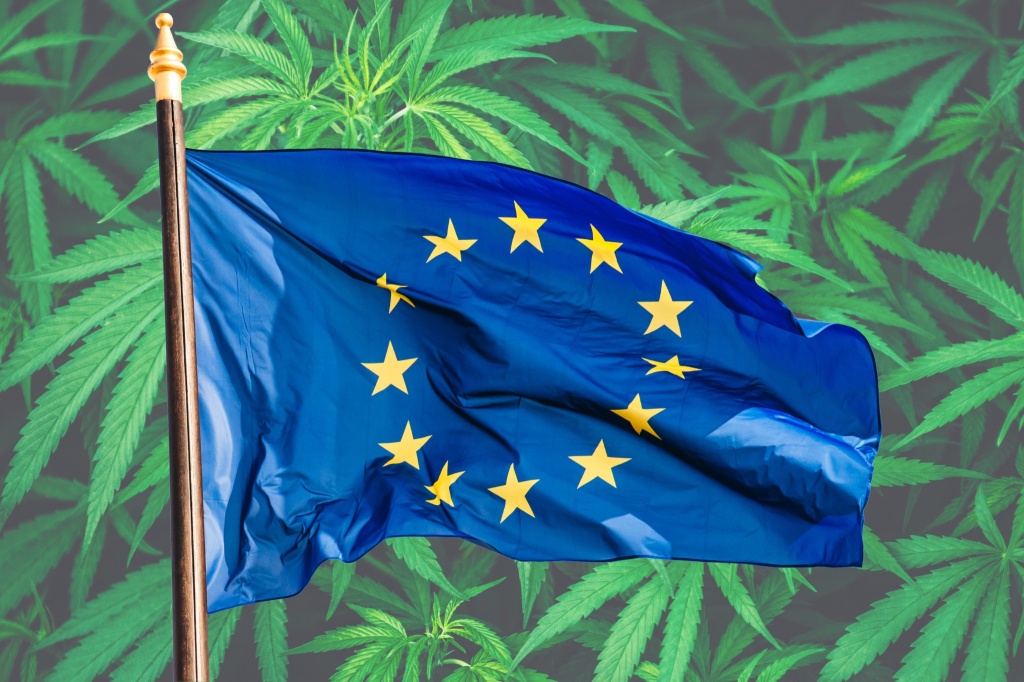
While news of rescheduling has dominated the U.S. cannabis news cycle, discerning eyes are also looking overseas. All around the world, the industry is emerging—some faster than others. According to a new report, Europe is quickly becoming a behemoth in the global cannabis market, a development that could have a far-reaching impact.
RELATED: DEA opens cannabis registration, but key questions remain
The report, a joint effort between the Global Cannabis Network Collective (GCNC) and Whitney Economics, declares the European Union (EU) is now the second-largest cannabis total addressable market globally by value. Like the U.S., the EU cannabis industry remains fragmented; however, growth in countries like Germany could shape the space across the continent and the world.
“The UK and the EU markets are very compelling right now; [they’re] still very nascent but full of tremendous growth opportunity,” Beau Whitney of Whitney Economics, told GreenState. “New entrants can help influence both policy and the arc of the industry for years to come.”
Europe’s cannabis market races ahead
The developments in the EU cannabis market are important to note, especially among politicians, operators, and investors in the U.S. As their industry advances, America could end up playing catch-up in a losing race.
Germany legalized adult-use cannabis in 2024, becoming the first major EU country to do so. While commercial sales remain restricted to medical marijuana, the market is still valued at around 2 billion euros. German operators imported roughly 200 tons of cannabis products in 2025 alone.
RELATED: More weed, less crime? New study says yes
Most of Germany’s cannabis comes from Canada, which fully legalized the plant in 2018. Analysts note that a lack of reform in the U.S. could leave domestic operators behind as lucrative import/export partnerships are solidified.
“Anticipate enhanced trade between the EU countries and expect protectionist policies to be enacted to shield domestic suppliers,” the authors wrote.
While Germany may be leading the pack in cannabis reform, others, like France, have remained hesitant. Still, the dominoes are falling faster than in the U.S.
The slow but steady rollout of regulated cannabis in the EU is also setting a model for other countries to follow, both politically and in terms of regulation.
“Expect Europe to begin taking more of a leadership role in the global cannabis movement,” the report reads. “The U.S. is mired in political dysfunction, and despite the fact it is the leading market from a monetary perspective, it has ceded its position from a policy perspective.”
Follow the money
For investors, much attention has been shifted to the EU. After chaotic stock swings in the U.S. and Canada, Whitney argues that the methodical, practical rollout in Europe makes it more predictable—and investable.
RELATED: Is marijuana medicine or menace? Trump officials seem split
[Medical] takes a while to deploy, and some would say that that limits the immediate commercial opportunity, but it’s also easier to predict the outcome,” Whitney explained. “That’s the trade-off between your commercial growth versus predictability and risk reduction from an investment perspective, and so that’s what makes these markets so compelling.”
When people think of cannabis, they often conjure images of Northern California as the epicenter. But with Europe quickly emerging as a force to be reckoned with on the global cannabis stage, the U.S. will need to take note if they want to cash in on the opportunities.
