


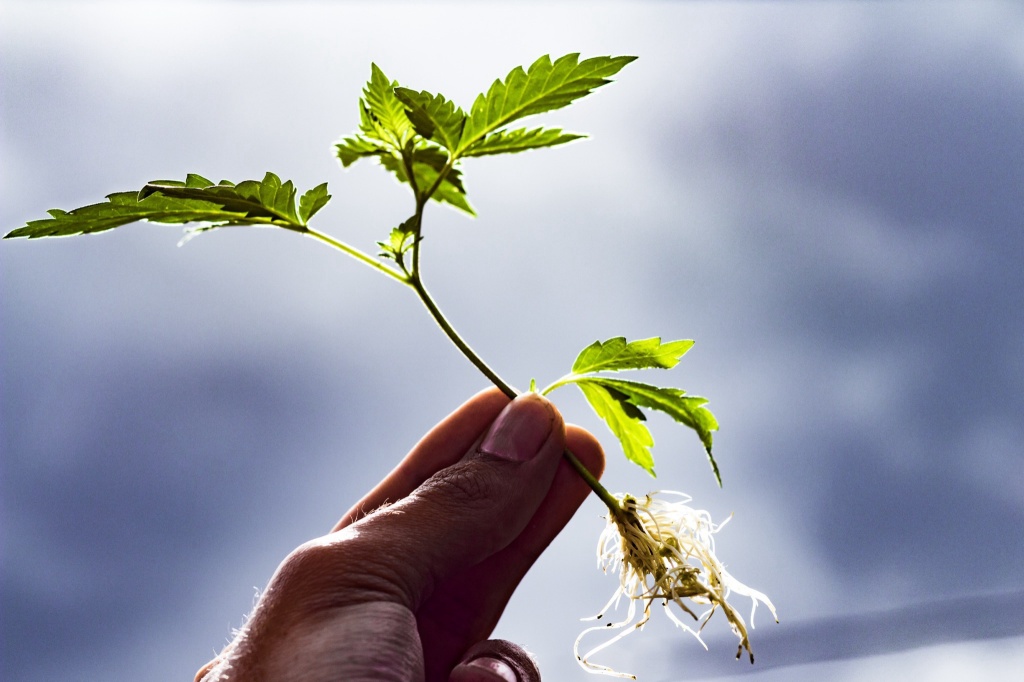
There are certain patterns you only start to recognize after working with cannabis for a long time. They only become visible when you try to carry something forward—across generations, across environments, across markets—and see what actually holds.
A lot has changed in the last forty years. The tools, the scale at which everyone operates, the legality, the expectations, the vibe. But these core challenges haven’t moved as much as people think, and I still think they constitute basic guidelines for anyone trying to participate in the cannabis market as a breeder, or understand where this industry seems to be leading.
RELATED: From Jamaica to Humboldt: The collaboration behind two new Bob Marley strains
At risk of being too blunt, I’d like to present the notion that most of what matters when it comes to cannabis breeding comes down to a handful of principles. They’re simple, but they rely on understanding cannabis as a crop and the implications that biology carries.
If it doesn’t hold, it doesn’t matter
One of the most common patterns in modern breeding is hybrid on hybrid: crossing examples of a plant to create a new strain. It’s efficient, and in a crowded market, it gives you something to present. You might get a plant that yields amazingly, looks exceptional, and tests high.
But when you try to reproduce it, it starts to move. The next generation won’t match. Then the next one shifts further. What looked like a result turns out to be a moment in a longer chain of biological events.
RELATED: This legendary pot breeder says they unlocked the future of weed
That’s where a lot of people get caught. I mean, real-life, honest breeders who get captured by the novelty rewards that the cannabis market might offer. So the bottom line is that if you’re trying to build something you can work with, improve, and rely on, that gap becomes a problem.
Over the years, working through different phases of the industry—much of it long before legalization—and now at scale through Barney’s Farm, that’s probably been the most consistent lesson. If it doesn’t hold, it doesn’t matter how good it looked once. You can’t build on it.
The plant makes more sense before you touch it
Before any structured breeding, there’s observation. That’s something I learned early, not from cannabis, but from farming.
Growing up on a farm in Ireland, I learned from my elders, who were constantly dealing with variation and uncertainty. Sometimes small adjustments lead to significantly different outcomes. You don’t control everything. In fact, you control almost nothing. So a farmer needs to learn how to read what’s in front of him.
That mindset carried over when I started traveling through India and other parts of Asia. I saw cannabis in a completely different context than the weed we were able to grasp in the 70s and 80s. That wild, free-growing cannabis was embedded in place and in culture. I got to move from one valley to another, and everything changed because the conditions changed.
RELATED: ‘These aren’t your granddad’s autos’: the caliber of autoflower seeds is rising
In India, especially, cannabis is widely used for charas, a hand-rubbed resin that has been produced for generations in regions like Himachal Pradesh. That process alone shapes how plants are selected. It favors certain resin characteristics.
Spending close to nine years moving through regions like Manali, Parvati, and Kerala, collecting seeds and observing local populations, gives you a reference point that is irreplaceable and, over the course of the decades, almost unreplicable today.
Those naturally occurring environments, with plants selected by Mother Nature herself over centuries, have been radically interfered with by human action throughout history. But don’t be discouraged. There are still some places where you can see naturally occurring characteristics of a strain without intervention.
Breeding is mostly about what you lose
There’s an assumption that breeding is about creating something new. In practice, it’s often the opposite. It’s about deciding what not to lose and not always succeeding.
Every backcross shifts the balance that leads to preserving certain traits while dropping others. Sometimes it’s obvious, sometimes it isn’t. You can lose something subtle and only realize it several generations later, when it’s no longer recoverable.
The process reflects that. It’s not unusual to run 40 or 50 parallel experiments and end up with five or six that are actually worth continuing. The rest fall away.
RELATED: Cannabis seeds sure to yield top-shelf bud
Technology has improved how we approach this. With current laboratory tools, you can take a single leaf and get early insight into cannabinoid profiles, terpene potential, and even structural tendencies. That allows you to narrow the field faster.
But it doesn’t remove the uncertainty. At some point, everything still has to be grown, tested, and observed under real conditions. That part hasn’t changed, and it probably won’t.
The industry changes its priorities, but the plant doesn’t
There was a period, not that long ago, when everything was driven by THC levels. The objective was clearly to increase potency, responding to demand largely driven by this, to get stronger weed and stronger hash.
What’s happening now is different. For instance, there’s more attention on terpene profiles, on how the plant expresses itself beyond strength alone, which brings complexity back into the process and changes how breeding decisions are made.
RELATED: The real reason weed names keep getting weirder
At the same time, the industry continues to move in cycles. New techniques emerge, like some of us working on triploid development and seeing promising results so far. Some of the work we’re doing now is focused exactly on that, particularly around stability under stress and hybrid vigor.
But even with all of that, the underlying constraints don’t change. The plant still responds to the environment, to handling, and to stress in ways that aren’t fully predictable. You can guide it, but you don’t fully control it.
If you want to build something long-term, you have to work that way
A lot of the pressure in cannabis still comes from the short term—what moves quickly, what differentiates, what tests well. That pressure is real, especially as markets become more competitive.
But it doesn’t align very well with how genetics develops.
Working from stable material, taking the time to select properly, and maintaining consistency across generations—that requires a longer horizon. It also requires the right conditions to do that work.
For a long time, during the prohibitionist years in which we learned to thrive and faced uncountable raids—alongside other setbacks—those conditions weren’t available. For decades, the work happened under constraints that resulted in interrupted cycles, loss of research, and loss of development. That limits what you can build.
RELATED: Weed might be secretly changing your taste buds – here’s how
Moving into the legal environment over the past three years changed that for us. Having that legal environment, proper facilities, and a functioning laboratory allows for a different level of continuity. It also places you within an ecosystem where ideas move quickly—large-scale pheno hunts, open exchange, and a new generation approaching the plant from different angles.
That combination—continuity and change—is where most of the progress happens. Barney’s Farm turns 40 this year.
Milestones like that are significant, although we almost got past the date without noticing. It caught us working our heads off, like every other year. What matters is whether the work continues to evolve and adapt while keeping its foundation. But don’t panic, we will hold a party.
There are still regions where cannabis genetics haven’t been overworked, where the plant is still expressing itself in ways that haven’t been fully explored. At the same time, regulations and increasing legalization processes in the U.S. and around the world continue to shape how genetics move and how they’re preserved. That tension has always been part of cannabis. We work within it.
*This article was submitted by an unpaid guest contributor. The opinions or statements within do not necessarily reflect those of GreenState or HNP. The author is solely responsible for the content.