


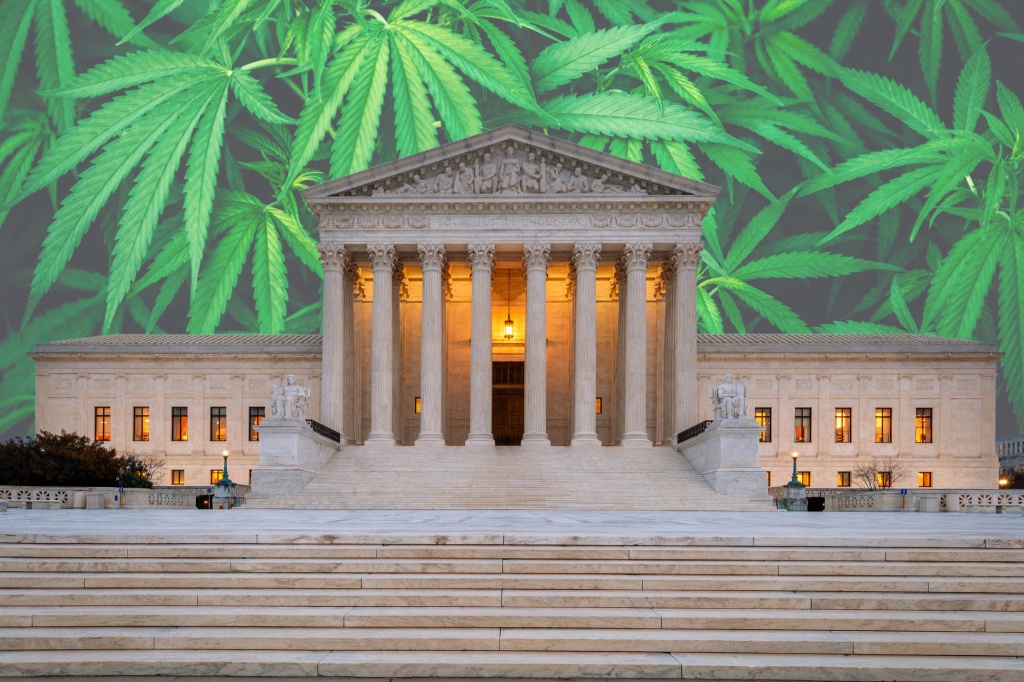
Should people who use cannabis be allowed to own guns? Federal law currently prohibits it — but the Supreme Court may narrow or strike down the ban in a case it’s now considering.
The Justice Department under President Donald Trump asked the justices to take up the case of a Texas man, Ali Danial Hemani, charged with a felony for allegedly keeping a gun at home while regularly using marijuana.
RELATED: When immigration enforcement collides with legal weed
Hemani’s lawyers got the charge dismissed after the 5th U.S. Circuit Court of Appeals ruled the ban unconstitutional under the Supreme Court’s expanded Second Amendment framework.
They pointed to the Supreme Court’s 2022 decision in New York State Rifle & Pistol Association v. Bruen. In that ruling, the court said modern gun restrictions must align with the nation’s historical tradition of firearm regulation.
The legal fight turns on more than one question. Beyond the “historical tradition” test, the justices are also parsing 18 U.S.C. § 922(g)(3), which bars anyone “who is an unlawful user of or addicted to any controlled substance” from possessing firearms.
Supporters say the law is meant to keep dangerous people from owning guns; prosecutors also used it against Hunter Biden, who was convicted of buying and possessing a gun while using illegal drugs. He was later pardoned by his father, President Joe Biden.
RELATED: Free CBD for seniors? What the Medicare proposal actually says
During oral arguments this week, justices across the ideological spectrum pressed the government on what, exactly, makes someone an “unlawful user.”
“What is the government’s evidence that using marijuana a couple of times a week makes someone dangerous?” asked Justice Amy Coney Barrett.
Barrett also raised a hypothetical about someone occasionally taking a spouse’s prescribed sleep medication, questioning whether that person, too, would lose Second Amendment rights.
Some justices signaled concern that a ruling for Hemani could weaken limits on gun possession by people who use more dangerous drugs, such as methamphetamine or heroin. If the categorical ban falls, courts could be pushed toward frequent, fact-intensive assessments of how risky a substance and a particular user is.
Justice Ketanji Brown Jackson suggested a ban on firearms for marijuana users may not have the historical roots Bruen requires.
“I think your argument sort of falls apart under the Bruen test,” Jackson said.
RELATED: New hemp bill in Congress could bring big changes
The justices also focused on what “unlawful” means in 2026. Cannabis is legal in many states but remains illegal under federal law. That legal mismatch, along with the federal proposal to move marijuana from Schedule I to Schedule III, came up repeatedly.
“What do we do with the fact that marijuana is sort of illegal and sort of isn’t, and that the federal government itself is conflicted on this?” Justice Neil Gorsuch asked.
The justices also drilled into the statute’s two phrases, “unlawful user” and “addicted to,” including what “addicted” should mean in practice. The statute doesn’t define “addicted,” but the Controlled Substances Act says it’s “any individual who habitually uses any narcotic drug so as to endanger the public morals, health, safety, or welfare.”
The case made for some unusual political alliances. The American Civil Liberties Union and the National Rifle Association both supported Hemani’s case, as did cannabis legalization groups like NORML. On the other side were gun-safety groups like Everytown that usually oppose the Trump administration on Second Amendment issues.
RELATED: ‘Shocking’: Minnesota cannabis leaders decry arrest of Nekima Levy Armstrong for ICE protest
Guns remain one of the country’s most polarizing issues. In 2023, nearly 47,000 U.S. citizens died from gun-related injuries. Firearms have been the leading cause of death for U.S. children and teens in recent years. Meanwhile, the gun lobby wields enormous influence, spending more than $114 million on lobbying since 2013.
Cannabis is also a major political issue. The vast majority of Americans support legalization. But the risk of losing gun rights has become a flashpoint for some marijuana users, especially in states where cannabis is legal.
The Supreme Court is expected to issue its ruling on the Hemani case in June. Some think the court could side with Hemani given the arguments, but the outcome won’t be known until the decision comes down.
*The Associated Press contributed to this report.
