


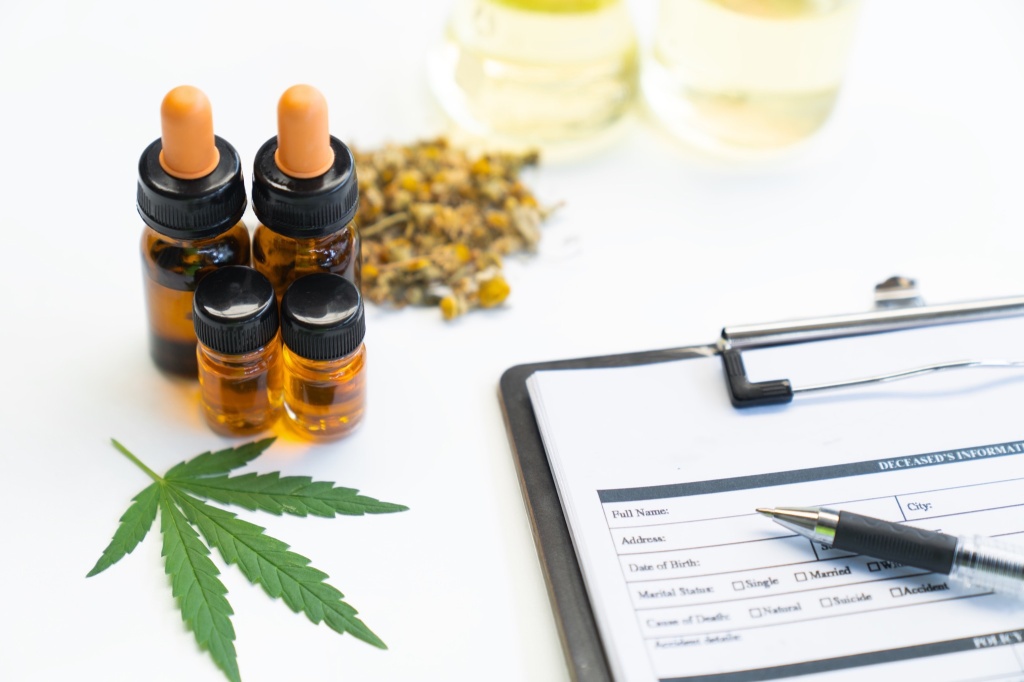
For decades, cannabis lived in the margins of healthcare, whispered about in waiting rooms and quietly relied on by patients long before anyone in a lab coat said it was okay. Now, as legalization spreads and stigma softens, the question isn’t just whether people use cannabis: it’s whether the systems built to manage our health are ready to acknowledge it.
In some corners of the insurance world, that shift is already happening.
RELATED: Cannabis in assisted living: What seniors and families need to know
When you apply for life insurance, the process known as underwriting is where insurers size you up as a risk: factoring in everything from age and medical history to habits like drinking and smoking. Tobacco users, for instance, typically face higher premiums because of well-documented health risks. But where does cannabis fit into that equation?
“We look at cannabis use in the context of how often and how it’s consumed,” said Nichole Myers, Chief Underwriter at life insurance company Ethos. Instead of treating cannabis as an automatic red flag, underwriting is beginning to resemble how insurers have long approached alcohol: frequency, method, and context all matter.
That nuance is doing real work.
“Casual or moderate use typically doesn’t disqualify someone,” Myers said. “We’re assessing real risk, not applying a blanket penalty.”
RELATED: Weed might be secretly changing your taste buds – here’s how
An occasional edible user, for example, lands in a very different category than a daily smoker, especially given the respiratory risks tied to inhalation. For medical patients, the equation shifts again. Coverage decisions hinge more on the underlying condition than the cannabis itself.
It’s a meaningful recalibration, and one that mirrors broader cultural changes.
“Beyond the legal landscape, we also see the data: we have thousands of people come through our platform every month, and responsible cannabis use has become a normal part of life for a lot of Americans,” Myers said. “Our job is to price risk accurately and not apply the stigma that the law itself is moving past. It’s an area where we’re trying to be thoughtful rather than applying a ‘one size fits all’ rule.”
Still, normalization is uneven. In healthcare more broadly, cannabis occupies a strange in-between space, embraced by patients and cautiously circled by institutions.
Lead broker at health and wellness program hub Association Health Partners, Stephanie Zink has watched that tension play out over decades.
“People have been craving this for a long time,” Zink said. “There is a lot of exposure happening within the pharmaceutical industry, and people are fed up. They want to be able to make their own choices. They want something different.”
RELATED: How AI is changing the way people buy and use weed
Zink’s perspective is rooted in lived experience, both personal and professional. She recalls knowing people who relied on cannabis medicinally long before it was legitimized, and she’s seen firsthand how stigma shaped policy and perception. Now, she sees that narrative cracking.
“We need to get away from this stigma of, ‘It’s just for getting high,’ because it isn’t,” Zink said. “But we had large corporations pushing that narrative for the better part of 100 years. So, we are at a critical moment in history in our country: to break away from things that do not work for us.”
A new kind of coverage
While traditional insurers are still recalibrating, a parallel ecosystem is already taking shape: one that treats cannabis less like a liability and more like a reimbursable part of care.
Vice President of Marketing and Chief Science Officer at EM2P2, Matthew Myro Rothman, works at the intersection of cannabis, tech, and insurance infrastructure. His company partners with brokers and third-party administrators to integrate cannabis into what’s known as an “alternative wellness stipend”: a benefits bucket that might also include acupuncture or chiropractic care.
The mechanics are surprisingly modern. Patients purchase products at participating dispensaries, then submit them through a digital platform for reimbursement, often up to $100 per month. Behind the scenes, the system integrates with point-of-sale data and maintains HIPAA compliance, positioning itself as a kind of bridge between cannabis and traditional electronic health records.
“We’re laying the digital pipeline for this to work when the floodgates open,” Myro Rothman said, pointing to potential federal rescheduling as a tipping point.
RELATED: Your smartwatch might know when you’re high
For now, though, the industry is still straddling two worlds. In adult-use states, Myro notes that medical cannabis sales often “plummet immediately” after legalization, with patients drifting into the broader recreational market. Insurance, historically absent from the equation, hasn’t been top of mind for dispensaries trying to stay afloat.
At the same time, stigma hasn’t fully loosened its grip.
“It’s a little bit of both,” Myro Rothman said. “The stigma is still very much intact. People are still buying into the old idea that there isn’t enough research, even though there are over 30,000 studies out there touting the plant’s medical benefits.”
That tension between normalization and hesitation, innovation and inertia defines cannabis in today’s healthcare landscape. Still, insurance companies are starting to ask better questions. Brokers are experimenting with new benefit structures. Tech platforms are starting to build the rails for a more integrated future.
Insurance may not be fully caught up yet. But for the first time, it’s in the conversation.