


Colorado’s experiment with legal natural psychedelics has attracted national attention, but the most interesting story in the state’s brand-new system isn’t happening in a hearing room or investor pitch deck. It’s happening in a small, quiet grow facility run by a woman who never expected to be here at all.
Before she became a facilitator and then Colorado’s first licensed psilocybin cultivator and manufacturer, Rhonda DeSantis was just trying to survive. For thirteen years, the mother of two lived inside the machinery of family court, repeatedly forced to recount abuse in an effort to protect her children. She describes the aftermath of one long stretch of testimony as a total physiological collapse.
“I was essentially a puddle on the floor,” she told an audience gathered for a recent Philadelic Conference at the University of Pennsylvania in November. “All of that testimony left me completely shredded.”
RELATED: R&B star says ‘shrooms cured her depression—and revived her career
It was a friend, not a doctor or a therapist, who pulled her into the orbit of psilocybin. The invitation was simple: come out to the ranch, take a breath, eat a small piece of mushroom-infused chocolate. DeSantis wasn’t looking for revelations. She wasn’t looking to “trip.” She was just looking for a moment where her body wasn’t in high alert.
She took the smallest bite she could. Nothing kaleidoscoped. Nothing melted or glowed. Instead, something softened. The first deep exhale, she says, she had felt in almost two decades. Over the next year, she returned to those low-dose sessions, gradually noticing that her nervous system didn’t hijack her when she encountered her ex-husband in public or relived stressful memories.
“I knew I needed to bring this to others,” she says now. “But only if I could remove the guesswork.”
The Operator Who Refused Guesswork
Psylutions, the company DeSantis eventually built, is almost the opposite of the free-form psychedelic culture that shaped the last half-century. Colorado’s quirky regulatory timeline, where decriminalization happened long before the formal framework, gave her an unusual head start: nearly two years to figure out what a regulated psilocybin supply chain should look like.
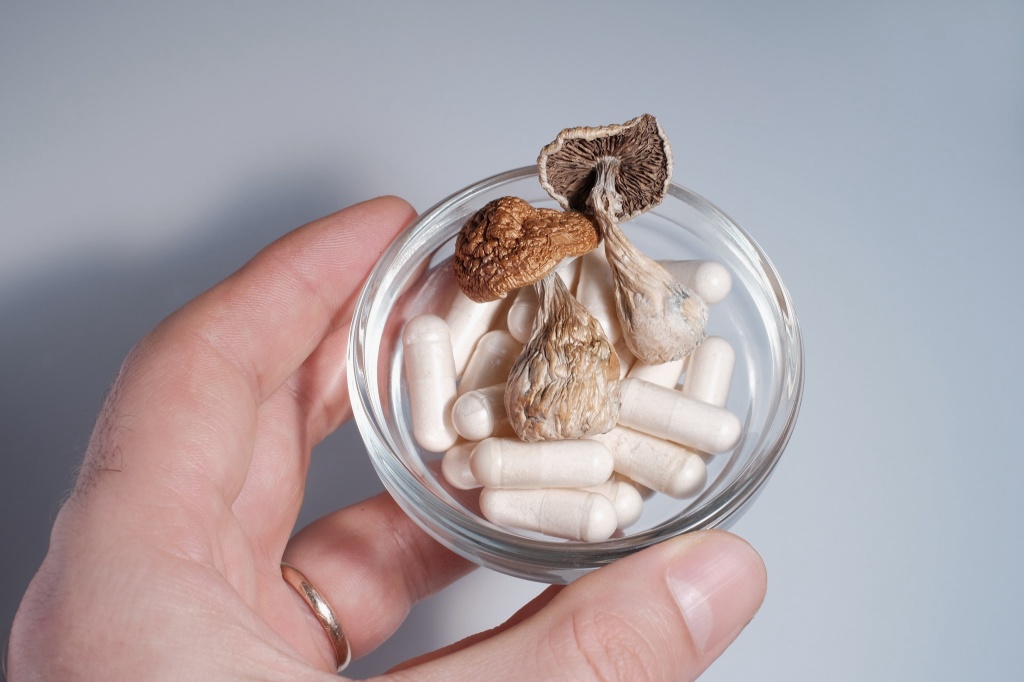
The biggest problem she saw was dosing. Most people take dried mushrooms measured in grams. A process that tells you almost nothing about actual psilocybin content.
“It’s like trying to take Tylenol by the ounce,” she said. “It’s not medicine. It’s guessing.”
So, she banned whole fruits from her facility. Every mushroom is homogenized, tested, and retested four times beyond what Colorado requires. If the goal is safety and predictability, she argues, then precision isn’t optional.
The Myth That ‘A Cube Is a Cube’
DeSantis also pushes back on a piece of psychedelic lore that’s been repeated for decades: that all psilocybin-containing mushrooms produce essentially the same experience. Psylutions currently grows seventeen mushroom strains and has started hybridizing others, each with its own chemical fingerprint. Over time, her team noticed that different strains seemed to resonate differently with people navigating grief, complex PTSD, identity work, depression, or substance-use recovery.
“It’s not that one is stronger or weaker,” she said. “It’s that they interact with different nervous systems differently.”
RELATED: Hotline bling, but for psychedelics: meet TripCheck
In other words: strain matters, especially if psychedelics are going to move out of the underground and into supervised, regulated care.
The Early Data — And Its Limits
Psylutions has now worked with more than 150 participants, from veterans and trauma survivors to older adults who would never consider taking a handful of dried mushrooms. DeSantis reports that, so far, they’ve seen no nausea, vomiting, paranoia, or violent agitation, symptoms long associated with raw mushroom consumption.
She credits this in part to removing the compounds that typically cause stomach upset. DeSantis, who suffered through severe nausea during both pregnancies, understood instantly why people fear vomiting on psychedelics.
“If someone is terrified of getting sick, they’re not going to fully engage with the experience,” she said.
Still, she’s clear: these outcomes are early, observational, and not clinical trials.
“Signals, not conclusions,” she stressed.
When the Whole Family Needs Healing
What sets DeSantis apart from the first wave of psychedelic entrepreneurs is her attention to the ecosystem surrounding a person: the family systems, the patterns that calcify over generations. In her view, individual healing is fragile when the environment remains unchanged.
“I’ve seen people come back from rehab and get dropped back into the same family dynamics that broke them,” she said. “Psilocybin could be a tool for healing the whole system, not just the identified patient.”
RELATED: A Hollywood icon’s unlikely love affair with LSD
It is a direction that makes her an outlier, and increasingly, a thought leader as states debate how to scale this new category of care.
Colorado as the Test Kitchen for the Future
Colorado’s natural-medicine model is the first of its kind, and the rest of the country is watching closely. The choices operators make now about dosing, safety protocols, strain standardization, access, and ethical guardrails will ripple outward into every state considering similar legislation.
For DeSantis, credibility is everything. Her long-term goals include pushing for federal rescheduling so universities and health systems can rigorously study natural psilocybin, building integrated care models that stretch across trauma, addiction, and even oncology, and shaping standards that withstand scientific and political scrutiny.
“I wasn’t looking for a trip,” she said. “I was looking for a way to live. That’s what this medicine gave me. If we want this industry to last, we must take real care with every single person who walks through the door.”
As Colorado’s psychedelic era begins, operators like DeSantis might be the ones who determine whether natural psilocybin becomes a trusted therapeutic tool or just another trend that couldn’t meet its moment.
*This article was submitted by a guest contributor. The author is solely responsible for the content.